Academic Program
Home >> About >> Academic Program
The INTEGRATIVE SCIENCE ACADEMIC PROGRAM, with its associated integrative MSIT science courses, served as a functioning and innovative science program at Cape Breton University from 1999-2007.
Follow this link to an overview of the work, supports, and relationships required to reinvigorate the Integrative Science academic program and BScCS degree (note: reinvigoration did not occur; both the program and degree ceased to function in the late 2000s).
A wealth of information about the Integrative Science academic program and MSIT courses is provided below, including status, curricular approach, successes and achievements, challenges, structure, etc. Additional detail such as key dates and developments during the evolution of Integrative Science can be found in the annotated time line provided in the Origins and History section of this website.
 ACADEMIC PROGRAM STATUS: Since 2007, the Integrative Science academic program and the four year Bachelor of Science Community Studies (BScCS) degree that houses it have essentially been "on pause" with no new student enrolment. Information on this website about the status of the Integrative Science academic program at Cape Breton University is current to June 2012 but will not be further updated. Updates will continue for other aspects of Integrative Science.
Many and diverse SUCCESSES, ACHIEVEMENTS, and CHALLENGES occurred in the Integrative Science academic program during the period 1999-2007. Read about some of these in an opinion piece in the March 2012 issue of University Affairs (or here as a pdf). Considerable additional and more specific information can be found further on in this section.
The ENABLING ASSUMPTION taken on by the Integrative Science academic program at the outset (mid-late 1990s) was: "that mutually respectful discussions about Nature can occur between the worldviews of Aboriginal/Indigenous Peoples and the worldview of Western Science ... i.e. that there is common ground between our knowledges, as well as differences which are to be respected." It was intended that this would create a new and attractive approach for Aboriginal students to pursue science at the post-secondary level. Program and course manuals (see below) were created to help foster these hopes and intentions ... and you can readily see how the 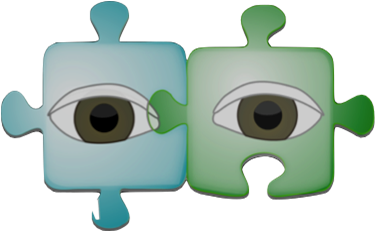 enabling assumption is congruent with our overall vision for Integrative Science - both its academic program and its research program.
TWO-EYED SEEING first came into use as the major guiding principle for Integrative Science in 2004, upon encouragement from Elder Albert Marshall of Eskasoni First Nation.
INTEGRATIVE SCIENCE ACADEMIC PROGRAM: THOUGHTTRAPS
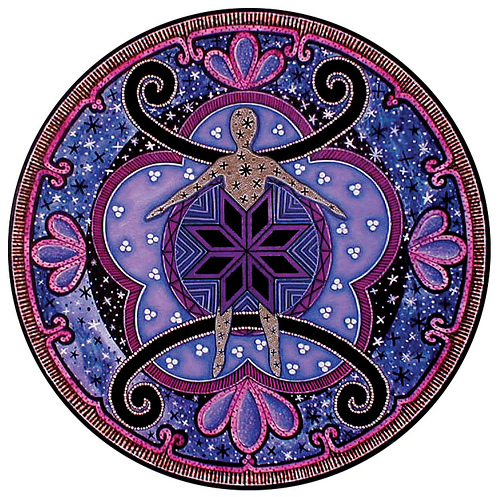 Manuals, called "ThoughtTraps" and featuring a cover image by artist Basma Kavanagh, were created in 2000-2001 for the Integrative Science academic program and some of its MS
IT courses (academic calendar course descriptions). Drafts were written by Cheryl Bartlett with input and feedback invited from students, research assistants, science colleagues, and educators and Elders in the Mi'kmaw communities of Cape Breton. The manuals were used (to varying extents) during 2000-2005.
Four ThoughtTraps were drafted and an additional two were envisioned; these were:
- ThoughtTraps ∞ Program Overview (pdf of 2001 teaching draft);
- ThoughtTraps ∞∞ Scientific Pursuit of Knowledge (pdf of 2001 teaching draft);
-
ThoughtTraps 1 - MS
IT 101/103 Sense of Place, Emergence and Participation (pdf of 2001 teaching draft, PLUS additonal materials for teaching "pattern") -
ThoughtTraps 2 - MS
IT 201/203 Ways of Knowing (pdf of 2001 teaching draft); -
ThoughtTraps 3 - MS
IT 301/303 Cycles and Holism; and -
ThoughtTraps 4 - MS
IT 401/403 Wholism: Health and Healing.
Intentions for the ThoughtTraps were:
-
that they serve as an outline or context for some of the topics and concepts covered in both the program as a whole and in its specific MS
IT courses. At the same time, we acknowledged that much of Indigenous Knowledge is "living knowledge" and cannot be oriented towards book-based learning. - that they help start the common ground discussions called for by the program’s enabling assumption.
- that they eventually would grow into a textbook for the program (while continuing to acknowledge, as noted for point #1 above, that Indigenous Knowledge is not book-based).
- that they, as draft teaching documents, would be seen as a beginning, not an end, i.e. that they were a “work in progress”. It was hoped that, over time, students, Elders, and others would help bring the ThoughtTraps to a fuller realization by adding more and appropriate understandings from the Mi’kmaw worldview, other Indigenous worldviews, and the Western scientific worldview ... and that they would also help to identify and articulate common ground.
- that constructive feedback for the ThoughtTraps was welcome from any and all (including and beyond the development team).
- that copyright be placed with the Mi'kmaq College Institute (MCI) at the university, recognizing the working partnership between the Integrative Science development team and MCI.
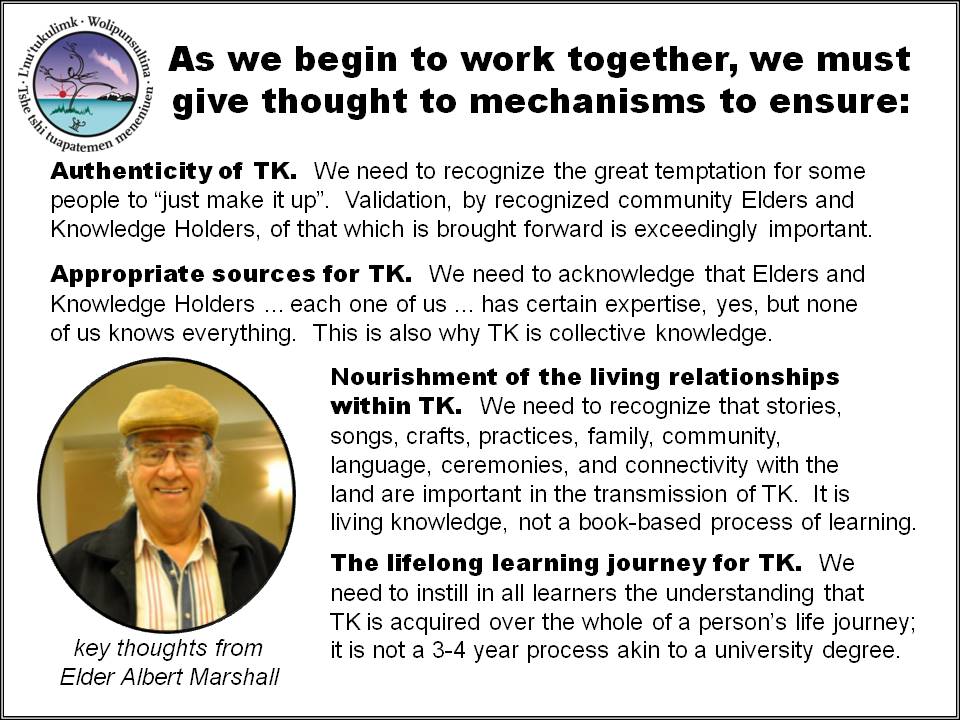
With respect to the above and other efforts to create teaching materials for Integrative Science (as well as similar or related educational endeavours), it is important to be mindful of the cautionary thoughts of Elder Albert Marshall with respect to Indigneous Knowledge (IK) / Traditional Knowledge (TK). Elder Albert's words are presented in the figure below. You can also view the entire 2012 presentation that features Albert's words, plus Eight Recommendations (for honouring IK / TK in educational institutions) as put forward by Aboriginal Elders in Atlantic Canada who worked collectively within an APCFNC research project. Additional contextual understandings for weaving IK / TK into educational curricula can be found in the 2012 article by Bartlett, C., Marshall, M., and Marshall, A.
INTEGRATIVE SCIENCE ACADEMIC PROGRAM: SUCCESSES, ACHIEVEMENTS, CHALLENGES, AND (SOME) EVOLUTION
A synopsis of the successes and challenges in the Integrative Science academic program was provided in an opinion piece by Cheryl Bartlett in the March 2012 issue of University Affairs (or here as a pdf).
Read more about the success of the Integrative Science academic program in having seen Mi'kmaw First Nations' students graduate with post-secondary science and science-related degrees up to and including Spring 2010.
Read more about the Mi'kmaw undergraduate students in the Integrative Science program who held NSERC USRAs (Natural Sciences and Engineering Research Council of Canada undergraduate summer research awards) or other summer research jobs at Cape Breton University.
Read about the Integrative Science academic program's national award of recognition from the Canadian Council on Learning in 2008 (announced in Fall 2009).
Read the article about the Integrative Science academic program that was published in the Fall 2008 issue of "Contours", the Faculty of Science Alumni Magazine of the University of Alberta.
Since 2007 (and as mentioned above), the Integrative Science academic program and the four year Bachelor of Science Community Studies (BScCS) degree that houses it have essentially been "on pause" with no new student enrolment. This development reflects various challenges faced, some at the outset in 1999 and some over many years, pertaining mainly to inconsistencies and insufficiencies in recruitment, budget, administration, and faculty. None-the-less, since 2007 some entry-level courses have continued to be taught under the MSIT label; however, their content has increasingly shifted away from the original intent set for them (more information below). Note: Information as to the status of the Integrative Science academic program and the MSIT courses was current to June 2012; it will not be further updated on this website.
A few specific insights as to the challenges faced by the Integrative Science academic program can be found in the presentation by Cheryl Bartlett and Albert Marshall at the March 2009 "Life Long Learning - from Youth to Elder" conference on Aboriginal education hosted by AAEDIRP (Atlantic Aboriginal Economic Development Integrated Research Program) and the Atlantic Policy Congress of First Nation Chiefs Secretariat.
Beginning in 2008, some entry-level courses began to be delivered under the MSIT label in Mi'kmaw communities for students in an access program leading to a Bachelor of Arts degree. These deliveries were independent of the originally defined structure for both the BScCS degree and its Integrative Science academic program. In addition, beginning in mid 2010, the courses themselves have increasingly been moved away from the vision, integrative curricula, and format originally conceived for them, with curricular emphasis now placed on fundamentals of western science rather than on Two-Eyed Seeing (note: course descriptions found in the current, i.e. 2012-2013, Cape Breton University academic calendar pertain to the original vision for MSIT courses from the mid-late 1990s, not to current status or content). Cheryl Bartlett and Mi'kmaw Elders have not been associated with MSIT courses or their delivery since July 2010.
During the period 1999-Spring 2010, Cheryl Bartlett (first as Professor of Biology, i.e. an individual faculty member / researcher, and later also as Canada Research Chair in Integrative Science and then additionally as Director of the Institute for Integrative Science & Health) fostered and enabled the MSIT science courses associated with the Integrative Science academic program in rich and diverse ways (funding sources can be viewed here). Normally, responsibility to fund an academic program and its courses would reside with one or more formal academic units (e.g. department and school) at the university, as would also the responsibility for academic integrity and operation of an academic program.
In July 2010, the BScCS Integrative Science academic program and its MSIT science courses were assigned to the new Indigenous Studies Department of Unama'ki College of Cape Breton University. This assignment includes departmental responsibility for academic integrity, operation, and funding of the academic program and its MSIT courses, as well as recruitment.
INTEGRATIVE SCIENCE ACADEMIC PROGRAM: ADDITIONAL INFORMATION
Infor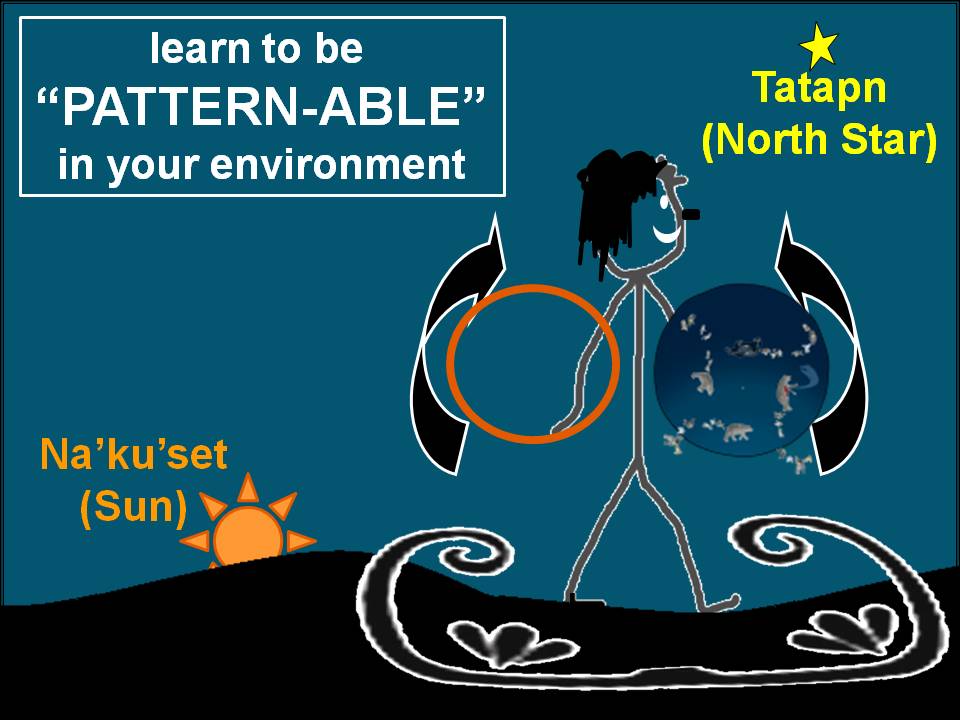 mation below about the vision, structure, and objectives for the Integrative Science academic program and its MS
IT courses pertains only to the program and courses as originally conceived and implemented in the mid-1990s to the mid-2000s.
Information below also includes an explanation of the Integrative Science academic program's early relationship, via its MSIT courses, to MSAP (Mi’kmaw Science Advantage Program). MSAP last ran in academic year 2004-2005.
In addition, you can read about the origins, rationale and history of the Integrative Science academic program, including a summary of its success in having encouraged Aboriginal students to consider post-secondary science or science-related programming and its success in having been recognized by a national award from the Canadian Council on Learning.
Academic Program Name – Integrative Science
Integrative Science, as an undergraduate academic program at Cape Breton University, is a concentration within the four year Bachelor of Science Community Studies (BScCS) degree. The Integrative Science academic program is also known by its Mi’kmaw name “Toqwa'tu'kl Kjijitaqnn” meaning “bringing knowledges together”.
The “integrative” in Integrative Science was chosen to highlight the understandings below.
- Participant involvement in “the knowing”. This refers to point #1 in our integrative framework
- Collaborative engagement among two (or more) epistemic communities. This refers to the bringing together of the different worldviews of Indigenous and Western sciences, which is our definition for Integrative Science and the intent behind the whole of our work. We have articulated this elsewhere as, for example, in our vision, our guiding principle of Two-Eyed Seeing, our theme of co-learning, and our thoughts on knowledge gardening.
- Ongoing nature of our co-learning journey. As noted for “integrative” as one of our themes in Integrative Science, we realize our work will be long and on-going and we pointed to the three letters “ive” that introduce the idea of action, of tending toward a state, especially in a regular or lasting way (Iwama et al. 2009, citing the 2002 version of “A Dictionary of Prefixes, Suffixes, and Combining Forms”). We also note that Newhouse (2004) indicates the work of grappling with each other’s cognitive universes and learning to see through the minds of others is the work of generations to come. It is important to note that we did not choose the word “integrated”, as this past tense implies a finished product.
Integrative Science academic program – Home Department
The functional home for the Integrative Science academic program's MSIT science courses at Cape Breton University, from 1999 until June 2010, was the Department of Biology within the School of Science and Technology. However, it is important to note that the Department of Biology was never officially assigned this responsibility. In July 2010, the Integrative Science academic program and its MSIT science courses were formally assigned to the new Department of Indigenous Studies in the new Unama’ki College of Cape Breton University (which in July 2010 replaced the entity formerly known as MCI, the Mi’kmaq College Institute at Cape Breton University).
Integrative Science Courses – MSIT
MSIT is the name given to the science courses that serve as the vehicles for Integrative Science / Toqwa'tu'kl Kjijitaqnn content at Cape Breton University. MSIT is a Mi’kmaw word meaning “everything together”. The various MSIT courses are open to students in any degree program at Cape Breton University. Completion of the Integrative Science academic program requires eight compulsory MSIT courses (all with labs) within the four year BScCS degree, along with 32 additional courses plus two work placements. The compulsory MSIT courses fall within the "concentration" part of the BScCS degree profile; the four parts that make up the BScCS degree are outlined in "Degree Structure" below.
The eight compulsory MSIT courses are designed as the four pairs which are named below along with an indication of the year within the four degree program where each pair was originally intended to fit. Each course is 3 credits (or a "half year" course; a pair equals 6 credits or makes up a "full year" course) and each course has a laboratory component. A description for each course pair can be found in the 2012-2013 Cape Breton University academic calendar. Or, you can view the original course descriptions here. Note: these descriptions pertain to the original conceptions for course content from the mid-late 1990s, not to curricular modifications that began around 2006 or to the greater modifications that followed.
The four pairs of compulsory MSIT courses, as conceived and originally numbered, are:
1) MSIT 101 & MSIT 103: Sense of Place, Emergence, and Participation (1st year)
2) MSIT 201 & MSIT 203: Ways of Knowing (1st year)
3) MSIT 301 & MSIT 303: Cycles and Holism (3rd year)
4) MSIT 401 & MSIT 403: Wholism: Health and Healing (4th year)
MSIT 101, 103, 201, and 203 were originally intended to provide a first year foundation in science, with a concurrent delivery of 101 and 201 followed by a concurrent delivery of 103 and 203.
Several elective MSIT courses were also designed, in addition to the eight compulsory MSIT courses. With the exception of MSIT 351 (renumbered later as MSIT 3105), their names and course descriptions have been omitted from the 2012-2013 Cape Breton University academic calendar on the university's website (but you can view the original course descriptions here). MSIT 3105 is also cross-listed as BIOL 3541; some of the other elective MSIT courses were similarly cross-listed as Biology courses.
Degree Name – Bachelor of Science Community Studies
The four year degree that houses the Integrative Science academic program at Cape Breton University is called the Bachelor of Science Community Studies (BScCS). Integrative Science is one of three academic programs (formally known as “concentrations”) to have been implemented within the BScCS degree; the other two are “Biodiversity” and “Psychology, Health, and Environment”.
Degree Structure – Bachelor of Science Community Studies
The BScCS degree requires 120 credits plus two work placements in a science or science-related environment. The overall degree structure consists of four parts (identified below) with each part originally designed to provide opportunities to learn science (see figure below for Integrative Science concentration). Additional information about each of the degree's four parts can be found in the Cape Breton University academic calendar or on the university's website (www.cbu.ca). Information in the university calendar is, however, incomplete with respect to requirements for the degree's core.
1. Core (science via small group topic choice in Community Studies courses)
2. Concentration (science via compulsory MSIT and other science courses)
- This part differentiates "Integrative Science" from other concentrations.
3. Electives (science via student's choice)
4. Work Placements (science via on-the-job experience)
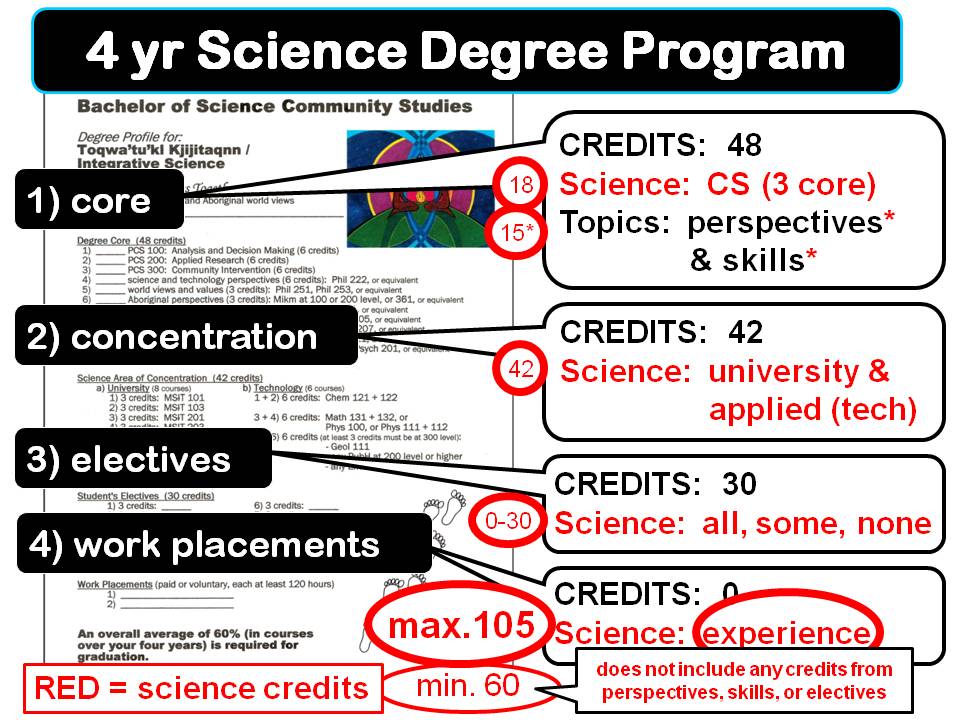
You can view the above-figured worksheet (without overlays) for the Integrative Science program (as originally conceived).
Degree Status
The Bachelor of Science Community Studies (BScCS) degree with its Integrative Science concentration is "on pause" within a period of potential for action towards re-invigoration. This recognizes evolving interests within communities and at Cape Breton University with respect to Aboriginal programming. As mentioned above, this status information is current to June 2012 but will not be further updated on this website.
Degree Graduates
In the period 2003-2010, there have been 13 Mi’kmaq students who have graduated with a "BScCS – Integrative Science". Read more about the success of the Integrative Science academic program, as here we only additionally note that in this same time period, there are 27 Mi’kmaw students who started and completed their science or science-related degrees at Cape Breton University ... all of whom have had some relationship to Integrative Science. The period 2003-2010 is our chosen focus given that the first students started in the Integrative Science academic program in Fall 1999 and thus the first graduates from the four year degree program could only be expected in Spring 2003.
Since the inception of the Bachelor of Science Community Studies degree at Cape Breton University in the late 1990's there have been three students (non-aboriginal) graduate with a "BScCS – Biodiversity", and no students with a "BScCS – Psychology, Health, and Environment".
Integrative Science – Overall Objective
The overall objective of the co-learning journey of Integrative Science, including that of the academic program component, is that participants – students as well as all others – learn to mindfully talk and walk together in mutual respect and thus develop a living knowledge of transcultural collaboration for the 21st Century. This derives from our vision for Integrative Science.
Integrative Science academic program – Original Program Objectives
The objectives of Integrative Science / Toqwa’tu’kl Kjijitaqnn, as originally conceived, were to:
- introduce Aboriginal understandings of Nature into the post-secondary science curriculum;
- recognize that there is Common Ground between the Western sciences and the Indigenous sciences and begin to articulate this common ground;
- recognize the differences between the Western sciences and the Indigenous sciences;
- foster a personal sense and understanding of “interconnectiveness and interdependence in our Universe” inclusive of Western and Indigenous perspectives;
- increase the participation and graduation rates of Aboriginal students in post-secondary science and technology programming;
- provide an innovative approach to post-secondary science education, open to all students regardless of ethnicity;
- employ mindful learning techniques, including awareness, asking questions, recognizing patterns and using metaphors; and
- do the above while also learning about both the Western sciences and the Indigenous sciences.
Integrative Science academic program – Relationship to MSAP (Mi’kmaw Science Advantage Program)
MSAP originated in 1998-1999 within Extension and Community Affairs (ECA) at Cape Breton University and became an initiative of the Mi’kmaq College Institute (MCI) at Cape Breton University when MCI came into existence in 1999-2000. MSAP, although an initiative separate from Integrative Science, had the similar objective of encouraging more Mi’kmaq students to enrol in post-secondary science. MSAP became a very successful recruitment vehicle for the Integrative Science academic program for several years because it was constructed as a package of courses suitable for a complete first year of university science and, in this regard, it included the four first-year Integrative Science courses (i.e. MSIT courses). MSAP has run in the academic years 1999-2000, 2000-2001, 2001-2002, 2003-2004, and 2004-2005.
Integrative Science academic program – Details about Graduates
In the period 2003-2010, there have been 27 Mi’kmaq students who started and completed their science or science-related degrees at Cape Breton University, all of whom have had some relationship to Integrative Science and many (but not all) of whom started university within the MSAP program. These graduates include 13 from the BScCS – Integrative Science plus 4 from the BSc – Biology, 6 from BSc – Nursing, 1 from BSc – Psychology, 1 from BTech – Public Health, and 1 from BTech – Environmental Studies. We note that individuals from Mi’kmaw communities are the only students who have enrolled in or graduated with the degree BScCS – Integrative Science, although the program is open to all regardless of ethnicity. Additional Mi’kmaw students who started their university journey with Cape Breton University’s Integrative Science courses within the MSAP program have graduated with other degrees, including the BA and BACS. Read more.
Integrative Science academic program – National Award of Recognition
In Fall 2009, Cape Breton University’s Integrative Science academic program received national recognition from the Canadian Council on Learning (CCL), as one of four effective learning practices across Canada to be celebrated within the category “Aboriginal Learning”. More information about this national recognition is available at: http://www.ccl-cca.ca/pdfs/SharingFlame/SharingTheFlame2009_EN_11dec.pdf
Integrative Science academic program – Additional Explanation
The interested person can find more information about the Integrative Science post-secondary academic program in our articles and presentations. We recommend:
1) Bartlett, C.M. 2011. Integrative Science/Toqwa’tu’kl Kjijitaqnn: The story of our journey in bringing together Indigenous and Western scientific knowledges. Chapter 17 in "Ta'n Wetapeksi'k: Understanding From Where We Come', Proceedings of the 2005 Debert Research Workshop, Debert, Nova Scotia, Canada. Eastern Woodland Print Communications, Truro, NS.
2) Bartlett, C., Marshall, M., and Marshall, A. 2012. Two-Eyed Seeing and other Lessons Learned within a co-learning journey of bringing together indigenous and mainstream knowledges and ways of knowing (authors' final draft). Journal of Environmental Studies and Sciences; accepted (July 2012): DOI 10.1007/s13412-012-0086-8
3) Bartlett, C., and Marshall, A. 2009. Integrative Science and Two-Eyed Seeing. Life Long Learning - from Youth to Elder; conference on Aboriginal Education, organized by the Atlantic Aboriginal Economic Development Integrated Research Program (AAEDIRP) of the Atlantic Policy Congress of First Nation Chiefs Secretariat. Fredericton, NB, 23-25 March 2009.
4) Bartlett, C., Marshall, M., Marshall, A., and Iwama, M. 2012. Integrative Science and Two-Eyed Seeing: Enriching the Discussion Framework for Healthy Communities (authors' final revised draft); Chapter 3 for book "Beyond Intractability: convergence and opportunity at the interface of environmental, health and social issues" edited by Lars K. Hallstrom, Nicholas Guehlstorf, and Margot Parkes (forthcoming). UBC Press.
5) Hatcher, A. 2012. Building cultural bridges with Aboriginal learners and their 'classmates' for transformative environmental education. Journal of Environmental Studies and Sciences, DOI 10.1007/s13412-012-0088-6
6) Hatcher, AM., and Bartlett, C. 2010. Two-Eyed Seeing; building cultural bridges for Aboriginal students. Canadian Teacher Magazine, May, pages 14-17
7) Hatcher, AM., Bartlett, C.M., Marshall, A., and Marshall, M. 2009. Two-Eyed Seeing in the classroom environment: concepts, approach and challenges. Canadian Journal of Science, Mathematics, and Technology Education, 9(3): 141-153.
8) Iwama, M., Marshall, A., Marshall, M., and Bartlett, C. 2009. Two-Eyed Seeing and the Language of Healing in Community-Based Research. Canadian Journal of Native Education, 32: 3-23.
.jpg)